Ask a chemist in any hill town what he sells most in January, and he’ll probably say cough syrup. Ask him what comes second, and you might be surprised, because it’s often lubricating eye drops. The air up there turns bone dry once the cold sets in, the wind scrapes across the slopes, and after a fresh snowfall, the sunlight bouncing off the white ground can leave your eyes stinging for hours. Come spring, it’s the itchy, watery eyes of pollen season. Then the monsoon arrives, and red, sticky eyes start going round the schools.
Nobody plans to buy eye drops. You wake up with a gritty eye, or a child comes home from school rubbing his, and suddenly you need a bottle before dinner. That habit of needing it right now, in every season, is a big reason to look at an Eye Drops PCD Pharma Franchise in Himachal Pradesh. In this guide we’ll go through how the business works, why the Himachal and the Baddi belt suit it, which drops sell, and how to choose a company. We’ll also tell you what we offer at Novalab Eyevision.
What Is an Eye Drops PCD Pharma Franchise?
PCD stands for Propaganda Cum Distribution. The eye drops are made, filled and labelled by the company under its own brand name. You get the selling rights for an area you’ve both agreed on, and you never have to deal with a manufacturing licence or a product approval. Your side of the deal is out in the field, visiting eye specialists, general physicians, eye hospitals, small clinics, and the chemist shops right next door to them.
Compared with a general range, it’s a small bag, and honestly that works in your favour. You won’t be knocking on every clinic door in town. Most of your week goes to a handful of eye doctors and the physicians who get eye complaints walking in daily. Win over an eye specialist once, and your drops can stay on his prescription pad for years.
Why Start an Eye Drops Franchise in Himachal Pradesh?
The weather is the first reason. Himachal’s long, dry winters and strong mountain sunlight are hard on the eyes. People who spend their days outdoors, farmers, drivers, labourers and anyone working in orchards, come in with dry, irritated eyes, and lubricating drops become a regular purchase. High-altitude sun also adds to eye strain, and doctors see plenty of patients asking for relief.
Each season brings its own trouble. In spring and early summer the air fills with pollen, and people walk into the chemist, rubbing their eyes and asking for something for the itch. When the rains come, conjunctivitis does its yearly round of classrooms and households, and antibiotic drops fly off the shelf. There’s hardly a month when the eyeshadow at a chemist’s counter stays quiet.
Then there’s age. More grandparents are living longer in Himachal, as everywhere else, and older eyes bring cataracts and glaucoma with them. A cataract operation always ends with a bag of drops for the weeks that follow. Glaucoma is different again, because those patients put drops in every single day for the rest of their lives. That kind of repeat buying is gold for anyone supplying them.
And then there’s competition, which is thinner than in the plains. Many PCD companies don’t bother with the long drives between hill towns. If you’re willing to cover that ground regularly, you can become the main eye-care supplier in places other companies ignore. An ophthalmic PCD pharma franchise in Himachal Pradesh rewards exactly that kind of persistence.
Eye Drops PCD Pharma Franchise in Baddi
Baddi is different from the rest of the state. Drive through it and you’ll pass factory gate after factory gate, with buses dropping off one shift and picking up the next. It’s one of the country’s biggest pharma manufacturing hubs, and thousands of people work there. Fine dust, chemical fumes and hours spent watching machines or screens wear the eyes down, and a speck in the eye or a minor infection is just part of a normal working week. Factory clinics, nearby hospitals and the chemists around them see a steady stream of eye complaints.
Families have moved in from across India to work here, which means demand for every kind of everyday eye product, from lubricants for tired eyes to antibiotic drops for children with infections. For an eye drops PCD Pharma franchise in Baddi, that’s a dense, busy market in a small area, with far less driving than the hill districts.
There’s a supply advantage as well. Sitting inside a manufacturing belt, orders tend to arrive faster and get stuck less often than they do further up the hills, so you can keep chemists stocked without tying your money up in a big storeroom. Plenty of partners start here for exactly that reason and only head up into the hills once they’ve found their feet.
Types of Eye Drops and Their Uses
Antibiotic eye drops are the backbone of most ranges. Whether it’s a child with a sticky red eye from school or a patient getting ready for cataract surgery, an antibiotic drop is usually the first thing written. They sell in every season, with a jump during the monsoon.
Combination drops come next. After a cataract operation, eye doctors often want two things in one bottle, something to keep infection away and something to calm the inflammation, so an antibiotic mixed with a steroid is very common. Some prefer an antibiotic with a painkiller instead for comfort in the first few days.
Then there are the quiet best-sellers, the lubricating drops people call artificial tears. They’re for eyes that feel dry, gritty or tired, and a lot of customers buy them without seeing a doctor at all. A farmer who’s been out in the winter wind all day, a factory worker in Baddi after a dusty shift, and a student who’s been on a laptop since morning. They all end up at the same shelf.
Allergy drops calm the itching, redness and watering that come with pollen or dust. Glaucoma drops do a very different job. They lower the pressure inside the eye and are used every day for years, which makes them some of the most valuable products a partner can carry.
Eye specialists also keep a few drops for their own work, like anti-inflammatory ones after surgery, dilating drops for a proper eye check-up, and antifungal drops for the occasional fungal infection. Nearly all of these need a prescription, and it’s the doctor who decides which one a patient gets. You’ll find our versions of each in the product table further down.
Benefits of an Eye Drops PCD Franchise in Himachal
Demand in Every Season:
You won’t have a dead month. When the winter dryness eases, the pollen arrives, and when the pollen settles, the rains bring infections. The eye shelf never really goes quiet.
Regular Repeat Orders:
Glaucoma patients use their drops every day, for life. Someone who’s had cataract surgery uses up the whole course. A person with dry eyes is back the moment the bottle runs out. Get a doctor writing your brand, and those reorders just keep turning up.
Light and Easy to Carry:
A full carton of eye drops weighs less than a few bottles of syrup. On hill roads, where freight adds up quickly, that saving matters, and you can keep samples and spare stock in the car without thinking twice.
Fewer Doctors to Visit:
You don’t need two hundred doctors. Five or six eye specialists, a couple of eye hospitals and some busy physicians are enough to build a decent business on, and you’ll actually have time to get to know each of them.
How to Start an Eye Drops PCD Franchise in Himachal and Baddi
Begin with an area you can really reach. In the hills, distance and weather decide more than anything, so pick a cluster of towns you can get to every week, snow or no snow. Or start in Baddi, where everything is a short drive apart. Then spend a couple of weeks just talking. Eye specialists will tell you what they write, chemists will tell you what sells and what keeps running out, and both will point you to the doctors who see the most eye patients.
Get your paperwork moving early. The wholesale drug licence, usually on Forms 20B and 21B, comes from the state drug licensing authority in Himachal Pradesh, and you’ll need GST registration as well. They’ll look at your storage space and want a registered pharmacist, or someone with the right experience, named on the application.
After that, talk to two or three ophthalmic companies. Go through their range, look at their certificates, ask how long dispatch takes, and request a few sample bottles. When you’ve made up your mind, put your products, your area, monopoly, any target and the length of the deal in writing.
Keep the first order focused. Two or three antibiotic drops, a couple of antibiotic-steroid combinations, a lubricant or two and one allergy drop are plenty to begin with. Glaucoma and surgery drops can come later, once the eye doctors have started trusting your name.
How to Choose an Ophthalmic PCD Company
Sterility is non-negotiable. These drops go straight into someone’s eye, so they have to come from a properly sterile plant. Ask where they’re made, and look at the WHO-GMP certificates yourself, dates included.
Look closely at the bottles. Squeeze one. A good dropper lets out a single, even drop; the cap closes tight, and you can actually read the label. Bottles that leak or need a strong thumb to squeeze irritate patients, and irritated patients don’t buy a second bottle.
Ask how they handle storage and transport, too. A few drops, like latanoprost among them, have to be kept cool until they’re opened, so the company needs to pack them properly, and you need to store them right. On hill roads in summer, this matters.
Find out how many days an order takes to reach you and what they do when landslides or snow shuts the roads. A company that plans ahead with you is worth more than one with slightly lower rates.
Range matters too. Antibiotics, combinations, lubricants, allergy, glaucoma and surgery drops from one company means you can look after eye specialists and physicians without juggling suppliers.
Monopoly Rights in an Eye Drops Franchise in Himachal and Baddi
Plenty of ophthalmic companies offer monopoly rights, whether you’re taking an Ophthalmic PCD Pharma Franchise in Baddi or covering the hill districts. In plain terms, nobody else from the same company is allowed to sell the same drops in your area, so the hours you spend convincing eye doctors aren’t handed to someone else.
Before you sign, ask for the exact area in writing. Is it Baddi on its own, a whole district, or a string of hill towns? Note down the products included, how long the rights last and any monthly target too. And when you look at that target, picture a slow month, with roads closed or tourists staying away.
Why Choose Novalab Eyevision for Himachal and Baddi?
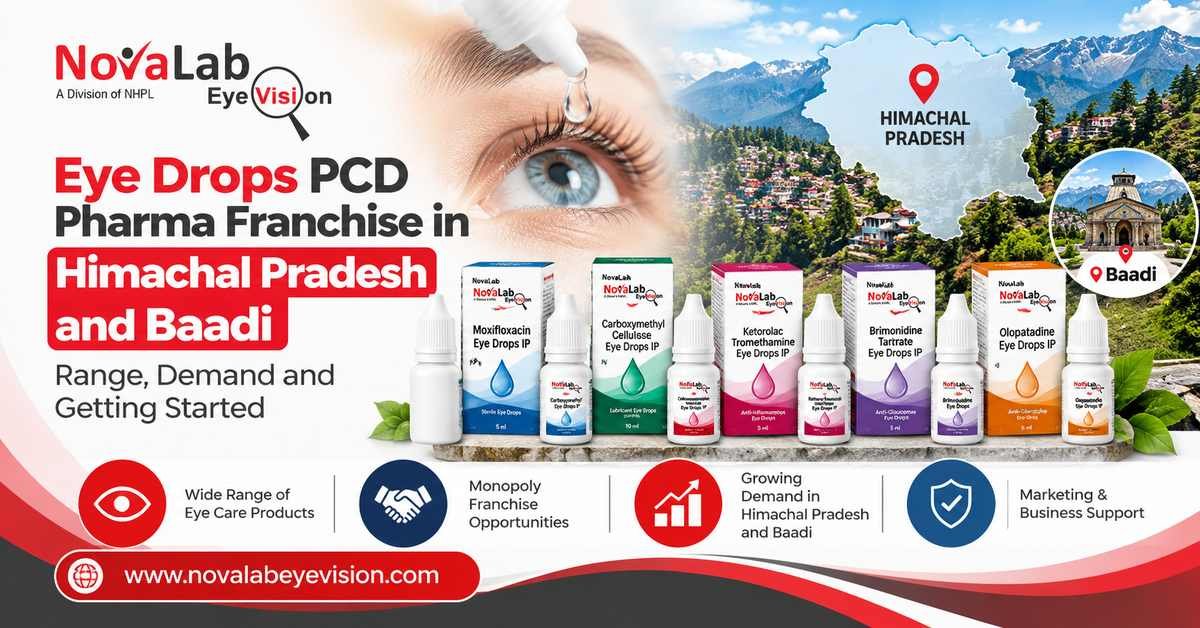
Novalab Eyevision focuses on eye care, with a WHO-GMP certified ophthalmic range, monopoly rights for franchise partners, promotional support and franchise support from day one. We also offer third-party manufacturing of eye drops.
Our eye drop range runs to more than fifty products. Here are some that partners in Himachal and Baddi usually start with:
| Product | Composition | Used For | Pack |
|---|---|---|---|
| MOXIKAST | Moxifloxacin 0.5% | Bacterial eye infections | 5 ml |
| GATYKAST | Gatifloxacin 0.3% | Bacterial eye infections | 5 ml |
| OFLODAZ | Ofloxacin 0.3% | Bacterial eye infections | 10 ml |
| TOBAKAST-M | Tobramycin 0.3% + Moxifloxacin 0.5% | Eye infections | 5 ml |
| MOXIKAST-D | Moxifloxacin 0.5% + Dexamethasone 0.1% | Infection with inflammation | 5 ml |
| MOXIKAST LT | Moxifloxacin 0.5% + Loteprednol 0.5% | After cataract surgery | 5 ml |
| MOXIKAST-KT | Moxifloxacin + Ketorolac | Infection with pain | 5 ml |
| CONINAC | Nepafenac 0.1% | Pain and swelling after cataract surgery | 5 ml |
| CONITEAR | Sodium Carboxymethyl Cellulose 0.5% | Dry eyes | 10 ml |
| HALOKAST | Sodium Hyaluronate 0.1% | Dry eyes | 10 ml |
| TEARS NOVA | Polyethylene Glycol 400 0.4% + Propylene Glycol 0.3% | Dry eyes | 10 ml |
| ALCAKAST | Alcaftadine 0.25% | Eye allergy | 5 ml |
| OLOKAST-KT | Olopatadine 0.1% + Ketorolac 0.4% | Eye allergy with discomfort | 5 ml |
| TIMOKAST | Timolol 0.5% | Glaucoma | 5 ml |
| LATOCRED | Latanoprost 0.005% | Glaucoma | 2.5 ml |
| LUMIKAST | Bimatoprost 0.01% | Glaucoma | 3 ml |
| TRAVOKAST | Travoprost 0.004% | Glaucoma | 3 ml |
| BRIMOKAST | Brimonidine 0.2% + Timolol 0.5% | Glaucoma | 5 ml |
| DAZDOR-T | Dorzolamide 2% + Timolol 0.5% | Glaucoma | 5 ml |
| TROPIKAST | Tropicamide 0.8% | Dilation for eye check-ups | 5 ml |
| CYCLOKAST | Cyclopentolate 1% | Dilation for eye check-ups | 5 ml |
| NETAKAST | Natamycin 5% | Fungal eye infections | 5 ml |
We also carry ear and nasal drops, so ENT doctors are covered too. If you’re thinking about an eye drops franchise in Himachal Pradesh or Baddi, give our team a call or drop a message. They’ll send you the complete list with rates, and let you know straight away if your area is already taken.
Conclusion:
Picture that hill-town chemist again in January, handing over eye drops nearly as often as cough syrup. In Himachal, eye trouble isn’t a seasonal fad. It rides in on the dry winters, the bright mountain sun, the spring pollen and the monsoon infections, and it stays with every older person managing cataract or glaucoma. Demand like that doesn’t rest on one good season.
Baddi adds a different kind of opportunity. A packed industrial town full of working families, eye complaints from dusty factory floors and long shifts, and supply that arrives quickly. Many partners start here and expand into the hills once their business is steady.
Whichever you pick, the basics don’t change. Take an area you can cover every week, begin with the drops doctors already write, store the delicate ones properly, and don’t let a chemist run dry. And go with a company that has sterile manufacturing, decent bottles, a full range and supply that still reaches you when the roads are bad.
If you’re ready to start an Eye Drops PCD Pharma Franchise in Himachal Pradesh or in Baddi, we’d be glad to talk. Novalab Eyevision has more than fifty WHO-GMP certified eye drops, monopoly rights for partners and support from your very first order. Get in touch with our team for the product list and rates.
Frequently Asked Questions:
Q.1 What is an eye drops PCD pharma franchise?
Ans. Simply put, an ophthalmic company hands you the selling rights for its branded eye drops in an agreed area. They make everything. You look after the eye doctors, physicians, chemists and supply.
Q.2 Is Himachal Pradesh a good place for an eye drops PCD franchise?
Ans. Yes. The dry winters, strong sun at altitude, spring pollen, monsoon infections and more older people with cataract and glaucoma keep the eye shelf busy all year. On top of that, fewer companies bother with the hill towns, so there’s room to grow.
Q.3 Why is Baddi good for an ophthalmic franchise?
Ans. Because so many people work in its factories, where dust, fumes and long shifts lead to eye trouble all the time. It’s also small and busy, and close to manufacturing units, so stock reaches you quickly.
Q.4 Which eye drops sell the most?
Ans. In most areas, antibiotic drops such as moxifloxacin lead the way, followed by antibiotic-steroid drops after cataract surgery, lubricants for dry eyes and allergy drops. Glaucoma drops are the ones that keep reordering for years.
Q.5 Which licence is needed?
Ans. A wholesale drug licence on Forms 20B and 21B from the state drug licensing authority in Himachal Pradesh, along with GST registration.
Q.6 Does Novalab Eyevision offer monopoly rights?
Ans. Yes. We offer monopoly rights to our franchise partners, so no other partner of ours can sell the same products in your area. Ask for the area and the terms to be written into your agreement.
Q.7 How should eye drops be stored?
Ans. Keep them somewhere cool and dry, out of direct sun. A few, latanoprost for example, need to go in the fridge until they’re opened, so read each label and follow what the company says.