Ask ten new distributors which line they want, and nine will say general medicines. That’s the crowded door, and the price war starts right there. Far fewer people look at eye care, which is odd, because for someone starting with limited money a narrow line is often the safer bet.
So this is the practical side of an eye drops PCD Pharma franchise in Haryana. What the work looks like day to day, what different Haryana towns tend to need, which licences you’ll chase, how to plan the money, and what Novalab Eyevision brings to the table.
What Is an Eye Drops PCD Franchise in Haryana?
PCD stands for Propaganda Cum Distribution, a long name for a fairly simple arrangement. The pharma company manufactures. You sell in your area under its brand, with its stock behind you. Orders go to the company and it dispatches, while you deal with the chemists, the clinics and the payment follow-up.
Here the brands are all about the eye: dry eye drops, allergy drops, antibiotic drops, glaucoma drops and now and then a tablet or a nasal spray. A typical chemist keeps plenty of general brands but only a few eye drops, and that thin shelf is where a franchise partner comes in.
Support differs from one company to the next. Some hand over a catalogue and nothing more. Others send visual aids and help with dispatch, and a few give territory rights. Ask what you’ll really get, and have it written down before you sign.
Why Consider an Ophthalmic PCD Pharma Franchise in Haryana?
Haryana isn’t one market; it’s several. Panchkula, Ambala and Karnal sit near Chandigarh and get a steady stream of patients. Gurugram and Faridabad are big and crowded, with hospitals and chemists on almost every road. Rohtak, Hisar, Panipat and Sonipat run on their own local clinics, and the villages around them lean on the town for medicines. With an ophthalmic PCD pharma franchise in Haryana, you pick the pocket you know best and build from there.
The buyer base is the real draw. Eye hospitals, ophthalmologists, general doctors and chemists all prescribe or stock eye drops, so there’s always someone to meet. Walk the market before you decide anything and count the clinics. See which chemists keep a decent eye range and which have two or three brands gathering dust, because a thin shelf is your opening.
Eye care also isn’t one product, which helps. Dry eyes and glaucoma need completely different medicines, and one supplier can cover a lot of prescriptions without you juggling five companies for a single chemist’s order.
Smaller towns? Worth a try, carefully. Sometimes branded eye drops are hard to get there and a dependable distributor becomes the go-to name within months, but sometimes someone already covers the town, or the doctors prescribe three brands and nothing else. You can’t tell from outside, so a small first order is the honest test.
And the range is small enough to learn. A general line throws hundreds of products at you, while this one has a handful of categories.
Understanding the Eye Drops Market in Haryana
Spend a week on the ground before any money moves. Eye drops don’t swap for one another: one bottle is a lubricant, the next an antibiotic, and another a steroid or a pressure-lowering drug, each written by a doctor for one particular problem. Nobody picks a glaucoma drop off the shelf on a whim.
So your sales ride on the doctors. If the eye specialists near you like a certain type of drop, those lines move and the rest sit. Expiry sharpens this, since eye drops have a short shelf life and many need special handling once opened.
Buyers are mostly independent medical stores, hospital pharmacies, eye clinics and other authorised distributors, and the cheapest research you can do is to ask them. What do you reorder most, and how often? What can’t you get? Keep a notebook. Honestly, those pages will do more for your first order than any brochure.
Types of Eye Drop Products for a Franchise in Haryana
Know the main categories before you pick a company. When you compare Ophthalmic PCD Pharma Franchise Products in Haryana, you’ll find most of them fall under the types in this table.
| Product Category | Common Ingredients or Examples | General Purpose |
|---|---|---|
| Lubricating Eye Drops | Carboxymethylcellulose, Sodium Hyaluronate | Relief of dry eye symptoms |
| Anti-Allergic Eye Drops | Olopatadine, Ketotifen | Management of allergic eye symptoms |
| Antibiotic Eye Drops | Moxifloxacin, Ofloxacin | Treatment of susceptible bacterial eye infections |
| Anti-Inflammatory Eye Drops | Nepafenac, Bromfenac | Management of specified inflammatory conditions |
| Glaucoma Eye Drops | Timolol, Brimonidine, Latanoprost | Lowering of eye pressure in indicated patients |
| Combination Eye Drops | Approved combinations of eye ingredients | Specific treatment needs |
These are general categories, not a confirmed list of Novalab Eyevision products. Prescription medicines should only be used as a qualified doctor directs.
Lubricating drops, or artificial tears, are the ones everybody has heard of. They go into dry, tired, irritated eyes. Some are thicker, some have preservatives, and some can be used more often than others, and doctors choose between them on that basis.
Anti-allergic drops are for the itchy, watery red eye that comes from an allergy. Which ingredient suits depends on the diagnosis. Antibiotic drops treat bacterial infections, full stop. A red eye isn’t automatically an infection, and good doctors don’t reach for an antibiotic until they’re sure.
Anti-inflammatory drops are used in specific cases, say after an eye procedure, and a few of them need close monitoring because wrong use causes trouble. Glaucoma drops bring down the pressure inside the eye. Patients usually stay on them for years and go back for regular check-ups, which means repeat orders for you. Most distributors like that part.
How Much Investment Is Required to Start an Eye Drops Franchise in Haryana?
There’s no single number. The cost shifts with the products you choose, how big the first order is, what premises you have and what terms the company offers. If someone quotes you a fixed figure without asking about any of that, they’re guessing.
What you can know is where the money goes.
| Investment Area | What It Covers |
|---|---|
| Initial Product Stock | First order of selected ophthalmic medicines |
| Licences and Documentation | Applicable drug licences and business registrations |
| Storage Arrangement | Suitable premises and required storage facilities |
| Transportation | Product delivery and distribution expenses |
| Marketing Expenses | Approved promotional materials and local business development |
| Working Capital | Reorders, running costs and customer credit |
| Business Infrastructure | Billing, inventory software and basic office needs |
One mistake shows up again and again. The budget is fixed, and almost all of it goes into the first order because a full shelf feels safe. Then a month passes. The reorder is due, one chemist is slow with payment, and there’s nothing left in the account. Start smaller than you think you should. Put a good chunk aside and add products only after you see what really sells.
Working capital is the line people forget. Chemists often pay after a few days, sometimes weeks, while your delivery costs, billing and salaries carry on regardless. Whatever cash you hold for that gap is what gets a new franchise through year one.
Documents and Licences Required in Haryana for an Ophthalmic Franchise
Selling medicines in India is regulated, so paperwork comes before the first sale. Most distributors need a wholesale drug licence and GST registration where it applies, along with PAN, business identity papers and address proof for the premises. Expect to show documents for the storage space and the details of a competent person as the drug rules require, plus your bank and billing information.
Wholesale drug licences are usually tied to Forms 20B and 21B, depending on which medicines you deal in. The state applies these rules, so speak to the Haryana State Drugs Control authorities before you begin. One visit or phone call at the start can save you weeks later.
How to Start an Eye Drops PCD Pharma Franchise in Haryana
It looks like a lot until you take it one step at a time. This is how most new distributors go about it.
Step 1: Research Your Local Market:
Pick your territory first, since everything hangs on it, then go and look. Chemists, clinics, and hospitals already supply eye products, which categories people ask for. A week of this beats any online report.
Step 2: Prepare Your Business Budget:
Write down what you need for opening stock, paperwork, storage, transport and working capital, with a number against each. The pull to buy a wide range on day one is strong. Resist it. Unsold stock ties up exactly the money you’ll need for reorders.
Step 3: Choose an Ophthalmic Pharma Company:
Ask a few companies for their latest catalogue and terms and lay them side by side: range, documents, how they handle supply, and what support they really give. A low rate is no use if stock turns up late.
Step 4: Verify Required Licences:
Sort out the drug licence and business registrations, and check that premises and storage meet the rules. People lose the most time here, so start early and keep copies of everything, because both the company and the authorities may ask for them.
Step 5: Select Your Product Range:
Match products to your survey and the company’s current catalogue. If it were our money, we’d start with one lubricant range, one anti-allergy and one antibiotic, then see what moves. A few categories are easier to stock, track and explain to doctors, and the range can grow later.
Step 6: Discuss Territory Rights:
Ask whether the rights are exclusive and get exact boundaries and conditions in writing. Which towns and which districts? Vague territory causes arguments later.
Step 7: Place Your Initial Order:
Before confirming, check quantities, expiry dates, rates, payment terms and dispatch plans. Expiry first, because short-dated stock is hard to sell. Size the order to what you can move in a few weeks, not to what looks impressive.
Step 8: Build Your Distribution Network:
Start with the chemists and buyers from your survey. Show them the products, give clear information and keep your dealings honest. After that it’s turning up on time with correct bills, again and again, and reliable supply builds a name faster than any pitch does.
Step 9: Monitor Sales and Inventory:
Track what’s moving, what’s near expiry, who owes you money and when to reorder. Look at it often. The numbers tell you honestly whether the business is working.
Benefits of a Monopoly-Based Ophthalmic Franchise in Haryana
A Monopoly Eye Drops PCD Pharma Franchise in Haryana means the company gives specified distribution rights in a defined area to one partner under agreed conditions. You’re its partner for that area, and it won’t appoint a second one beside you for the same products.
The benefit is clarity. With the territory in the agreement you know where you can work, and if the exclusivity is properly respected you won’t meet another franchise of the same company at your chemists’ counters. It also lets you put your time into local doctors and chemists instead of racing someone from your own supplier, and a stable territory makes stock easier to plan.
Don’t read too much into it. Monopoly doesn’t remove competition from other brands and it promises no sales or profit. It gives you a fair field, nothing more.
Important Things to Check Before Choosing an Ophthalmic Pharma Company in Haryana
Price is a small part of this decision. A cheaper rate means nothing if the stock arrives late or the paperwork has gaps.
Documents first. Ask for the relevant manufacturing and product permissions, along with labels and supporting papers. Quality and storage next. Eye products go in or near the eyes, so the bar is higher than for many other medicines. If you want a WHO-GMP Eye Drops PCD Pharma Franchise Company in Haryana, ask the company for its certificate and check it yourself. Learn the storage and handling instructions for each product as well.
Then ask about stock. How fast do orders go out, and what happens when something runs out? What’s the policy on near-expiry, damaged or unsold stock? A company that answers these clearly is usually one that has dealt with them before.
After that, the commercial terms: rates, minimum order quantities, payment conditions, taxes. And read the franchise agreement itself, not a summary of it. Territory rights, how it can be ended, who is responsible for what and how disputes are handled all sit in there. One last question: what approved product information and promotional material will you get? That’s what you’ll be showing doctors.
Common Challenges in the Eye Drops Franchise Business in Haryana
Every distribution business has its problems. Better to meet them on paper first.
Slow-moving stock comes first. Some products just don’t sell in a given area, so keep a record of sales by product and don’t pile up what isn’t moving. Expiry is next. Eye drops have a fixed shelf life and may need special handling once opened, so follow the storage instructions and sell older batches first. That’s the first-expiry-first-out method.
Customer credit hurts quietly. When payments run late you’ve less cash for reorders, so set a clear credit policy and follow up on dues. Supply gaps are another one. If a product isn’t there when a chemist needs it, the chemist goes elsewhere, so stay in regular touch with your supplier and order ahead.
Then competition. Other distributors and well-known brands may already be there. You’ll compete best with steady service and correct information, never with medical claims you can’t support.
Why Choose Novalab Eyevision for an Eye Drops PCD Pharma Franchise in Haryana?
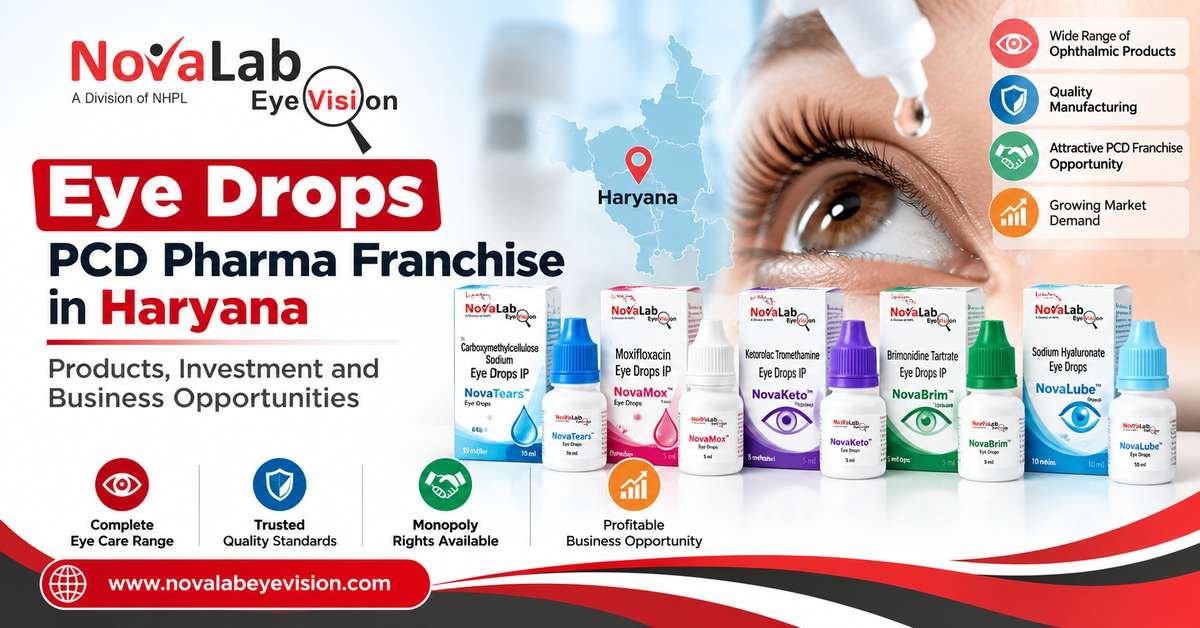
Novalab Eyevision is a pharma business focused on ophthalmic products. It offers eye-care products, PCD franchise opportunities and third-party manufacturing. Going by its published information, the focus is on eye drops and other eye formulations instead of a spread across unrelated categories.
Its website lists eye drops, tablets and nasal sprays. That’s useful for a distributor because a range centred on one field is easier to learn and easier to talk about with doctors.
On the franchise side, Novalab Eyevision works with distributors and other eligible partners who want to handle ophthalmic products. It also advertises third-party manufacturing for businesses that want eye-care products under their own brand. The company describes product information, professional help and promotional support as part of how it works with partners. Exact support and terms can differ, so confirm the full package before you sign.
The company is also close to the market you’re looking at. Its listed address is Plot No. 208, Industrial Area, Phase 1, Panchkula, Haryana, 134113. If you want an Eye Drops PCD Pharma Franchise in Haryana, contact the team and ask about the current catalogue, available territories and franchise requirements.
How to Grow an Ophthalmic Franchise Business in Haryana
Growth comes from doing the basics well, over and over. More products come last.
Start with products picked from real customer demand and the supplier’s approved catalogue. Keep inventory accurate by tracking batches, expiry dates, purchase quantities and sales. Small distributors often lose money here without noticing.
Look after your customers with clear billing, quick replies and orders that arrive when promised. Go through your numbers regularly: sales, margins, collections and how fast stock turns over. When it’s time to expand, go slowly. Add a new product or a new area only when the current business is steady and enough working capital stands behind it.
Conclusion:
If you have modest capital, a market you know and the patience for repeated visits to doctors and chemists, an eye range is a sensible first franchise. If you want volume from week one, a general line will feel faster, but you’ll pay for that speed in competition.
Whichever way you lean, the basics decide it: know your local market, pick a small range, finish the licensing first, keep cash for reorders and watch expiry dates. An Ophthalmic PCD Pharma Franchise in Haryana also needs a close look at the company behind it, along with the territory terms and commercial conditions, so read everything before you agree.
Novalab Eyevision offers an eye-care focused range and franchise services from Panchkula. When you’re ready, contact the team to discuss current products, distribution requirements and the opportunities available in Haryana.
Frequently Asked Questions:
Q.1 What is an Eye Drops PCD Pharma Franchise in Haryana?
Ans. It’s a distribution arrangement where an authorised partner markets and distributes a company’s ophthalmic products within an agreed territory in Haryana, while the company handles manufacturing and supply.
Q.2 How can I start an Ophthalmic PCD Pharma Franchise in Haryana?
Ans. Research your market, prepare a budget, get the applicable licences, choose a pharma company and read the franchise agreement carefully. Then begin authorised distribution with a small, focused range.
Q.3 Is a drug licence required for an eye drops franchise?
Ans. A suitable drug licence is generally needed for wholesale distribution of regulated ophthalmic medicines. The exact requirements depend on the products and the business activities, so confirm them with the state drug authorities.
Q.4 How much investment is needed for an ophthalmic franchise?
Ans. It varies with the opening stock, setup, storage needs and the supplier’s terms, and there’s no fixed amount for everyone. Plan for working capital along with the first order.
Q.5 Which eye drops can be included in an ophthalmic franchise?
Ans. That depends on the supplier’s approved range. Products may include lubricating, anti-allergic, antibiotic, anti-inflammatory and glaucoma-related eye drops.
Q.6 Does an ophthalmic PCD franchise provide monopoly rights?
Ans. Some companies offer territory-based rights. Whether they’re available, and on what conditions, must be confirmed in a written agreement.
Q.7 Which cities in Haryana can be considered for an eye drops franchise?
Ans. Possible markets include Panchkula, Ambala, Karnal, Panipat, Sonipat, Rohtak, Hisar, Gurugram and Faridabad. Real opportunity depends on territory availability and your own market research.
Q.8 Does Novalab Eyevision offer ophthalmic PCD franchise opportunities?
Ans. Yes. Novalab Eyevision advertises PCD pharma franchise services and an eye-care focused product range. Interested distributors should contact the company for current details.