Browse any B2B directory for contract eye drops and you will see asking prices from about ₹40 to ₹185 a bottle, sometimes for similar strengths. That spread is the first thing to understand about eye drops third party manufacturing in India. A licensed plant makes the product and your company puts its name on the carton. The price you pay depends less on the bottle than on the molecule and the license behind it.
If you don’t own a factory, there are two legal routes. The manufacturer can produce under its own license, or you can apply for a loan license and make your products at its plant under your name. Both are covered below, along with the sterility checks that matter far more for ophthalmic products than for tablets.
How the arrangement works
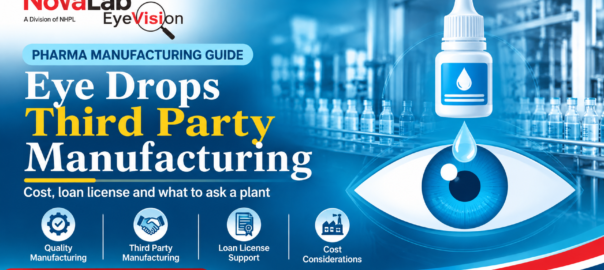
The brand owner handles marketing and distribution. The plant handles filling and batch testing, then ships. Novalab Eyevision’s third party manufacturing service lists four stages: product selection, packaging and branding, manufacturing support, and order and delivery coordination. It pitches the model at pharma companies, marketers and healthcare businesses that want an ophthalmic range without building a plant.
The law has no neat label for this. The law firm King Stubb & Kasiva points out that the Drugs and Cosmetics Rules, 1945 contain no express provision for contract manufacturing, so deals run on the license types the Rules do define.
You will also see “ophthalmic contract manufacturing” used for the same service. One Himachal manufacturer draws a line between the two: with contract manufacturing you bring your own formula, with third party you pick from the plant’s range. Third party suits you if you have prescribers who trust your name and no capital for cleanrooms. Contract manufacturing suits you once you have a formula worth protecting.
Loan license or the manufacturer’s license?
A loan license lets a company without its own factory make drugs at another licensed manufacturer’s premises. Goa’s drug regulator describes it in a licensing guide that also says the loan licensee needs a wholesale license. Applications go to the state drug control department, and the governing text is Rule 75A of the Drugs Rules, 1945.
Labelling is where this goes wrong in practice. The same law firm cites a court case where drugs were made in breach of loan license terms and labelled in breach of Rules 96 and 97. Whose name goes on the carton, and in what form, is a legal question and not a design one.
Under the other route, the manufacturer’s own license covers production. Pushkar Pharma’s guide adds a catch: if you use the plant’s formulations, you do not own them. That sounds minor until you want to move your best seller to a cheaper plant and find the formula stayed behind.
If you plan to build a brand around a few molecules over several years, raise the loan license at the first call. It adds an application to the state authority, but it gives you a document in your own name when questions arrive.
Rules and fees vary by state, so confirm the current procedure with your state drug control office or a regulatory consultant before signing anything.
What eye drops manufacturing cost actually depends on
Directory listings give a rough picture of third party eye drops pricing, and only a rough one. A supplier on TradeIndia asks ₹95 for 5 ml olopatadine 0.1% drops, with a minimum order of 500 pieces, and ₹105 and ₹130 for two of its other products. A Kindcare listing asks ₹180 for a 15 ml carboxymethylcellulose 0.5% bottle at the same 500 minimum. Another supplier lists 10 ml ofloxacin at ₹40 and a 5 ml ofloxacin and dexamethasone combination at ₹185, on a separate IndiaMART page.
Eye drops manufacturing cost swings with the molecule more than anything else. One Mohali exporters page shows a basic eye drop at ₹30 to ₹40 a piece and a bimatoprost drop at ₹738.37. It also lists a 5,000 bottle minimum for a bromfenac drop, ten times the 500 bottle floor above. At an illustrative ₹100 a bottle, that is the difference between ₹50,000 and ₹5 lakh of stock.
The bottle itself is cheap. A plain plastic dropper bottle can cost ₹1.50 at 5,000 pieces. What you pay for is the cleanroom filling and the testing behind every batch.
Compare quotes by what each one leaves out. Ask whether the carton, leaflet, artwork changes, stability data and GST sit inside the price. A quote that is ₹15 lower and excludes those is the more expensive quote.
None of these listings says what is included, and a directory price is an invitation to call, not a quote. If you would rather see a finished range before commissioning custom work, start with the eye drops range.
The part a quote won’t show: sterility
In 2023 the CDC linked an outbreak of extensively drug-resistant Pseudomonas aeruginosa to artificial tears sold as EzriCare and Delsam Pharma. The CDC notice says the manufacturer, Global Pharma of Chennai, recalled three products. Later reports counted three deaths and eight cases of blindness.
The FDA said the manufacturer had not done proper microbial testing and had skipped tamper-evident packaging. The company said early on it had not determined whether its own facility was the source. In eye drops third party manufacturing the same pattern holds: the brand names on the carton, and not the plant’s, appeared on the CDC notice.
Indian rules have tightened since. The health ministry set 31 December 2025 as the deadline for small and medium units to meet the revised Schedule M. Business Standard reported in December 2025 that only about 1,700 of an estimated 6,500 such units had submitted upgrade plans, and that roughly 2,000 already held WHO-GMP certification. So a plant’s Schedule M status is now a fair question to ask, and a fair one to ask in writing.
Eye drops also need aseptic filling in a Grade A/B cleanroom, according to Pushkar Pharma’s guide, so a plant that mostly makes tablets may not be set up for them. Novalab Eyevision’s quality policy names air handling units and HEPA filtration, plus per-batch testing of pH, osmolarity, viscosity and seal integrity. Whoever you choose, ask for the same level of detail.